
Overview
ReviewLens is a full-stack analytics and discovery platform designed to transform large-scale Amazon review data into trustworthy, interpretable product intelligence.
Modern e-commerce platforms contain millions of products and reviews, yet users still struggle to answer key reliability questions:
- Which products are genuinely high quality?
- Which reviewers provide trustworthy opinions?
- How can users discover strong but overlooked products?
ReviewLens integrates product metadata, review history, and reviewer behavioral analytics into a unified exploration interface that supports both search-driven and discovery-driven workflows.
The system supports interactive product analytics, reviewer credibility modeling, and graph-based recommendation over millions of records while maintaining real-time query performance.
My Role & Ownership
ReviewLens was developed in a four-person academic team. I led the project’s end-to-end implementation and was responsible for bringing the data, database logic, backend services, and user experience together as a working product.
My primary ownership included:
- Designing and building the React and Material UI frontend, including product search, reviewer analytics, recommendation views, interactive tables, charts, and detail modals
- Writing and optimizing the project’s most computationally intensive PostgreSQL queries, reducing multi-minute analytical workflows to interactive response times
- Contributing across the data cleaning, ETL, relational schema, Express API, ranking logic, testing, and full-stack integration
- Translating analytical ideas such as reviewer behavior, hidden-gem discovery, and co-purchase recommendations into usable product features
Although the project was completed in a team setting, I owned the core technical implementation and the majority of the final product experience.
Dataset & Data Engineering
Dataset Scale
ReviewLens integrates two public Amazon 2018 datasets:
Review Dataset
- 6,739,590 records
- 12 attributes:
- ASIN
- reviewerID
- review text
- star rating
- timestamp
- helpful vote count
Product Metadata Dataset
- ~2 million records
- 19 attributes:
- title
- brand
- category hierarchy
- price
- product features
- also-bought / also-viewed relationships
Together, the system processes 13M+ structured and semi-structured rows across multiple relational entities.
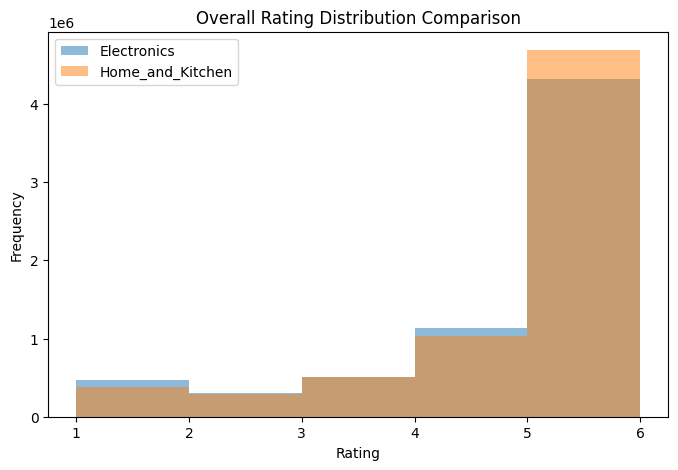
Data Preparation Pipeline
Raw Amazon data is distributed as nested JSON.GZ files requiring substantial transformation before relational ingestion.
1. Incremental Data Loading
- Stream-loaded compressed JSON files in chunks to avoid memory bottlenecks
- Retained only analytical attributes relevant to ranking, recommendation, and reviewer modeling
2. Type Casting and Validation
- Converted rating fields into numeric types with domain constraints (1–5 scale)
- Normalized helpful vote counts into integer format
- Converted Unix timestamps into standardized temporal fields for time-series aggregation
3. Text Cleaning and Normalization
- Removed HTML tags and malformed encoding artifacts
- Standardized whitespace and entity formatting
- Cleaned product feature fields for consistent indexing
4. Nested Structure Flattening
Amazon metadata contains multiple nested arrays that were exploded into relational tables:
- also_buy relationships → recommendation graph table
- also_view relationships → browsing similarity graph
- category hierarchy → dimension table
- image URL lists → reduced to canonical representative image
5. Storage Optimization
- Exported cleaned data into Parquet and compressed CSV formats
- Enabled fast PostgreSQL ingestion and analytical scan efficiency
Database & Schema Design
The relational schema models the Amazon review ecosystem as a hybrid graph-relational system.
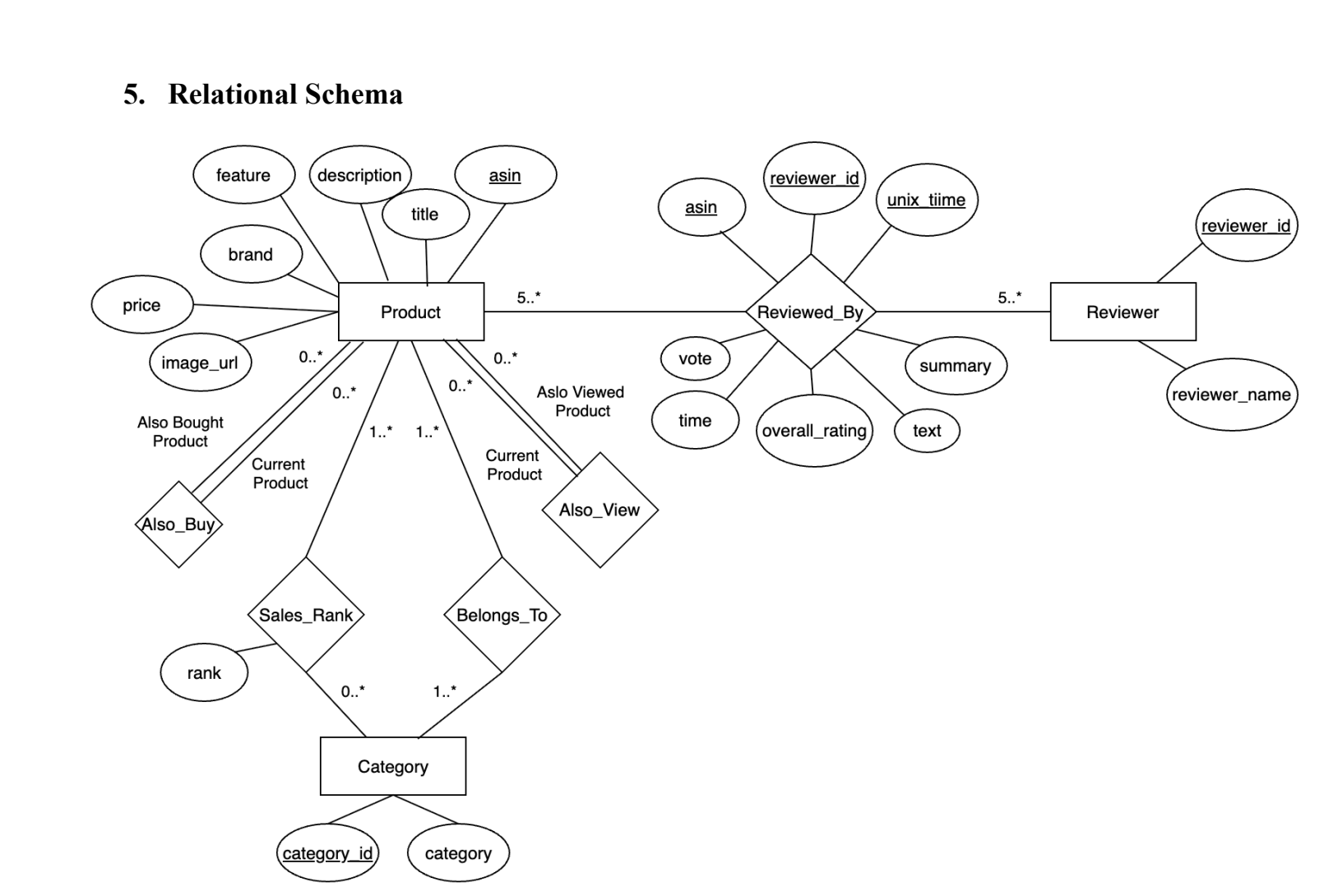
Core Tables
Product
Stores static metadata including:
- ASIN
- title
- brand
- description
- feature keywords
- price
- representative image
Reviewer
Stores reviewer identity and behavior tracking.
Review
Composite primary key:
(asin, reviewer_id, unix_time)
Stores:
- rating
- review text
- helpful votes
- timestamp
This structure ensures each review instance is uniquely traceable.
Category Dimension
Allows multi-category mapping for products through a bridge table.
Relationship Graph Tables
- also_buy
- also_view
These tables support graph traversal queries used for recommendation ranking.
Design Advantages
The schema supports:
- Multi-dimensional analytical aggregation
- Graph-based product discovery
- Reviewer behavior statistical modeling
- Efficient join-based ranking pipelines
Platform Features
1. Product Search & Exploration
The Home interface serves as the global discovery entry.
Users can:
- Search by product name or ASIN
- Filter results by category or rating threshold
- Sort products by review volume or average rating
Each product result exposes key summary metrics:
- Average rating
- Total number of reviews
- Brand and pricing metadata
2. Product Detail Analytics
The product detail modal integrates multiple analytical modules:
Rating Stability Visualization
Displays monthly rating trends allowing users to detect:
- Sudden quality shifts
- Long-term reliability patterns
- Seasonal rating behavior
Helpful Review Ranking
Ranks reviews based on helpful vote count, highlighting high-signal user feedback.
Graph-Based Recommendation
Surfaces “customers also bought” relationships that allow navigation through product co-purchase networks.
3. Category-Level Product Intelligence
Category dashboards implement multiple ranking algorithms.
Top Products Ranking
Ranks products using a composite score combining:
- Average rating
- Review volume
- Category ranking metrics
Hidden-Gem Discovery (“Surprise Me”)
Identifies long-tail products defined as:
- Above-category-average rating
- Low review volume quartile
This feature intentionally balances popularity bias and promotes product diversity.
Always-Positive Products
Identifies products with:
- No review rating below 4 stars
- Minimum review count threshold
This provides high-confidence reliability signals.
4. Reviewer Behavior Analytics
ReviewLens introduces reviewer-centric trust modeling.
Top Reviewer Leaderboards
Two ranking dimensions:
- Total review count
- Total helpful votes received
These metrics identify influential and active reviewers.
Reviewer Rating Style Classification
Reviewers are classified based on statistical deviation from global rating distributions:
- Lenient reviewers → systematically high ratings
- Neutral reviewers → distribution near global mean
- Strict reviewers → systematically lower ratings
This allows users to contextualize subjective reviewer bias.
Reviewer Profile Exploration
For each reviewer, the platform provides:
- Most recent reviews
- Highest-impact reviews (by helpful votes)
- Aggregated metrics:
- average rating
- rating standard deviation
- review volume
Recommendation Engine
The recommendation module leverages Amazon co-purchase graphs.
Weighted Scoring Model
Each candidate recommendation receives a composite score:
- In-degree popularity within also_buy network
- Product average rating
- Total review volume
Score = w₁(popularity) + w₂(avg_rating) + w₃(review_count)
This hybrid scoring balances reliability and popularity while reducing noise from sparse products.
Query Optimization & Performance Engineering
Handling multi-million row datasets required extensive SQL optimization.
Optimization Techniques
Indexing
- ASIN indexing for product joins
- Reviewer indexing for behavioral aggregation
Materialized Aggregates
Precomputed:
- product rating summaries
- reviewer statistics
- category ranking tables
Query Rewriting
- Reduced join depth
- Replaced nested subqueries with CTE pipelines
- Eliminated redundant aggregations
Performance Improvements
| Query Task | Original Runtime | Optimized Runtime |
|---|---|---|
| Graph-based recommendation | >10 min | 412 ms |
| Category ranking by rating quantiles | 4m 16s | 1.26 s |
| Reviewer classification | 1m 35s | 1.58 s |
| Hidden gem discovery | 39 s | 528 ms |
These optimizations enabled interactive dashboard latency.
System Architecture
Backend
- PostgreSQL analytical database
- Node.js and Express REST API service layer
- SQL-driven ranking and aggregation pipelines
- Pagination-based lazy loading for scalability
Frontend
Built using:
- React
- Material UI component library
- Chart.js and Recharts
- Lazy-loaded data tables
- Chart-based rating trend visualization
- Modal-based deep-dive analytics
The UI supports cross-navigation between products, reviewers, and categories.
Technical Challenges
Large-Scale Relational Joins
Multi-table joins across reviews, metadata, and graph relationships required careful indexing and query decomposition.
Semi-Structured Data Normalization
Amazon metadata contained nested arrays and inconsistent formatting requiring:
- schema normalization
- entity explosion
- text cleaning pipelines
Balancing Discovery vs Popularity Bias
Designing ranking metrics required blending statistical reliability and exploration heuristics.
Business Value
ReviewLens enables users to make informed purchasing decisions by providing:
- Transparent reviewer credibility modeling
- Product quality stability analysis
- Long-tail product discovery tools
- Data-driven recommendation navigation
Conclusion
ReviewLens demonstrates how large-scale review ecosystems can be transformed into trustworthy recommendation intelligence through:
- scalable data engineering
- relational and graph hybrid modeling
- behavioral analytics
- full-stack visualization dashboards
The system delivers real-time exploration over millions of records while preserving analytical interpretability.
Future Work
- Sentiment-based NLP modeling for review interpretation
- Personalized recommendation using collaborative filtering
- Real-time review streaming pipeline
- Cross-category user preference modeling
Cover Image Credit: me