Overview
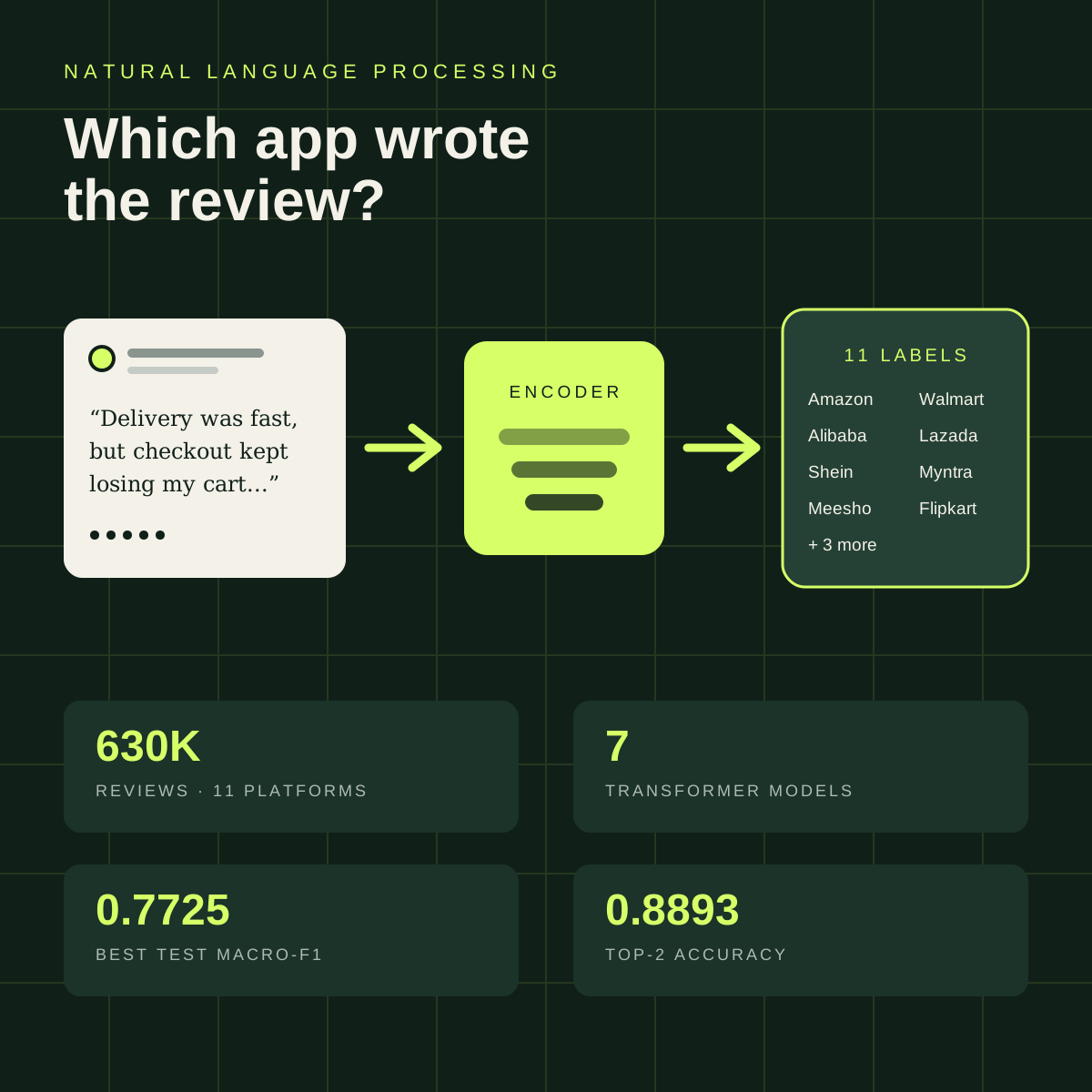
Can the source of a shopping review be identified from its language alone? This project frames that question as an 11-class text-classification task spanning global shopping platforms. Beyond maximizing accuracy, the work focuses on two risks that make the problem deceptively difficult: unequal class sizes and direct brand mentions that can leak the answer into the review text.
The final workflow combines reproducible data splits, leakage analysis, classical NLP baselines, class-imbalance experiments, and a shared Transformer evaluation pipeline. Across seven pretrained architectures, DeBERTa-v3-base achieved the strongest test result: 0.7725 Macro-F1, 0.7716 accuracy, and 0.8893 Top-2 accuracy.
My Contribution
- Implemented the shared scoring workflow and reported accuracy, Macro Precision, Macro Recall, and Macro-F1.
- Built the word-frequency baseline and TF-IDF models using Logistic Regression and Linear SVM.
- Integrated brand-name masking and class-imbalance experiments into the evaluation workflow.
- Debugged the batch Transformer training and evaluation pipeline, standardized result collection, and preserved model-level outputs for comparison.
- Synthesized the findings into milestone reports and the final project presentation.
Data and Task Design
The dataset contains 630,000 public shopping-app reviews from 11 platforms. A stratified 80/10/10 split produced:
- 504,000 training examples
- 63,000 development examples
- 63,000 held-out test examples
Each record includes the review text, star score, helpful-vote count, timestamps, optional platform reply, and the source app label. Modeling intentionally centers on content; the goal is to learn platform-specific language rather than metadata shortcuts.
Leakage-Aware Baselines
An audit found that roughly 29% of reviews explicitly mention an app or brand name. That signal is useful in production but can make an academic benchmark artificially easy, so the baseline workflow evaluated both raw and masked review text.
The initial word-frequency method reached 0.3484 Macro-F1. TF-IDF with Logistic Regression raised raw-text performance to 0.7021 Macro-F1. Under brand masking, the baseline reached 0.5514 Macro-F1, providing a more conservative reference point for imbalance experiments.
Handling Class Imbalance
The largest label contained about seven times as many observations as the smallest. Two data-level SMOTE variants were compared with an algorithm-level class-weighting strategy over sparse TF-IDF features.
- Standard SMOTE: 0.5482 Macro-F1
- Borderline-SMOTE: 0.5555 Macro-F1
- Class-weighted Logistic Regression: 0.5802 Macro-F1
Class weighting worked best because it changed the optimization objective without fabricating interpolated points in a sparse, high-dimensional text space.
Transformer Benchmark
Seven pretrained encoders were fine-tuned under a shared configuration and evaluated by the same pipeline. This made model comparison reproducible across validation accuracy, Macro-F1, weighted F1, Top-2 accuracy, per-class metrics, and confusion matrices.

All seven models landed within a relatively narrow performance band. DeBERTa-v3-base led the benchmark, followed by RoBERTa-base and BERT-large. The compact DistilBERT model remained competitive, finishing only 1.69 percentage points behind DeBERTa in Macro-F1.
What the Results Mean
The project produced three practical lessons:
- Evaluation design matters as much as architecture. Direct brand mentions can inflate apparent performance, so masked and raw-text results should not be treated as interchangeable.
- Class weights fit sparse NLP features better than synthetic oversampling. SMOTE’s geometric interpolation was less effective in TF-IDF space.
- Larger models did not automatically win. DeBERTa-v3-base outperformed BERT-large, while the seven Transformer results differed by only about two Macro-F1 points.
The final Transformer benchmark used the original review text, so it measures end-to-end platform recognition rather than a fully de-lexicalized test. A stronger next iteration would repeat the Transformer comparison on masked text, remove near-duplicate reviews across splits, and report repeated-seed confidence intervals.
Engineering Deliverables
- One-command batch training and evaluation across seven Transformer architectures
- Shared label mapping and tokenization rules
- Automatic checkpoint discovery and standardized metric collection
- Validation and held-out test reporting with confusion matrices
- Separate baseline, leakage, and class-imbalance experiments